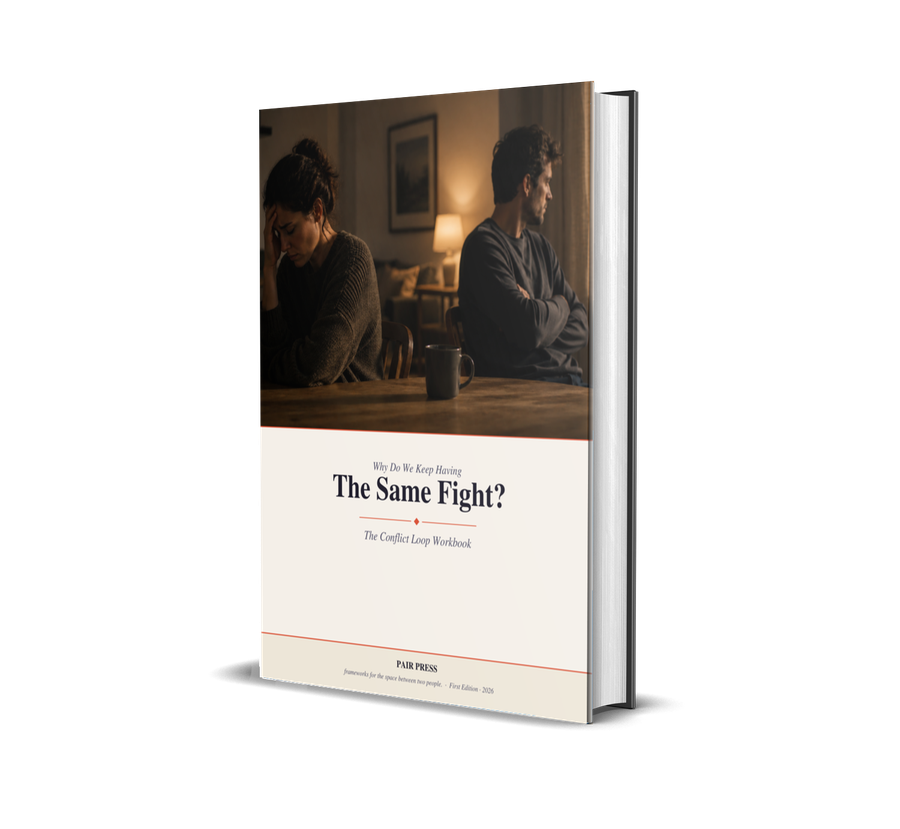
The Conflict Loop Workbook

73% of couples repeat the same 3 arguments. Forever.

It's never really about the dishes, the money, or who said what. It's the pattern underneath — the loop you both fall into without noticing. This workbook helps you see it, name it, and break it.

Frameworks for the space between two people.

Instant download Private & self-guided 20-page PDF

Gottman's 40-year study found 69% of relationship conflicts are never fully resolved. The goal isn't to win — it's to break the loop.

Sound Familiar?

You're not fighting about what you think you're fighting about.

The same argument keeps coming back wearing a different outfit. Different trigger, identical ending. Here's what that loop feels like from the inside.

01

The replay

You can predict exactly how it'll go — who says what, who shuts down, who walks off. And it still happens anyway.

02

The silence after

It "blows over," nothing actually changes, and you both quietly brace for the next time it surfaces.

03

The distance

Each loop chips away a little more. You're not enemies — you're just two people slowly drifting out of sync.

The Conflict Loop Workbook — hardcover edition

The Workbook

Why Do We Keep Having the Same Fight?

A structured, self-guided workbook that walks you through your own conflict loop — so you can finally interrupt it instead of repeating it. No therapy jargon. No homework you'll never do. Just a clear path you work through at your own pace.

20-page PDF workbook 3 steps · 7 worksheets Do it solo or together
₹299
One-time payment · instant download
Get Instant Access
What's Inside

Three steps. Seven worksheets. One pattern, finally visible.

The workbook moves you through a single clear arc: spot the loop, give it a name, and build the tools to break it. Every worksheet is built to be used, not just read.

Step 1 · Identify

Map the loop

Three worksheets to pinpoint your repeating argument, trace its trigger, and capture the four moments where it always plays out.

Step 2 · Name It

Give it a name

A guided worksheet to name your loop out loud. Once it has a name, it stops being "you vs. me" and becomes "us vs. the pattern."

Step 3 · Break the Loop

Interrupt the cycle

Three worksheets plus ready-to-use scripts for the moment the loop starts — so you have a different move to make in real time.

Foundation

What a loop actually is

A plain-language grounding in why the same fight repeats — and the four moments every loop runs through.

Ongoing Practice

A tracker that sticks

A simple progress tracker and check-in to keep the new pattern alive long after the first read-through.

Support

Know when to reach out

Honest guidance on when a workbook is enough — and a curated list of professional and crisis resources for when it isn't.

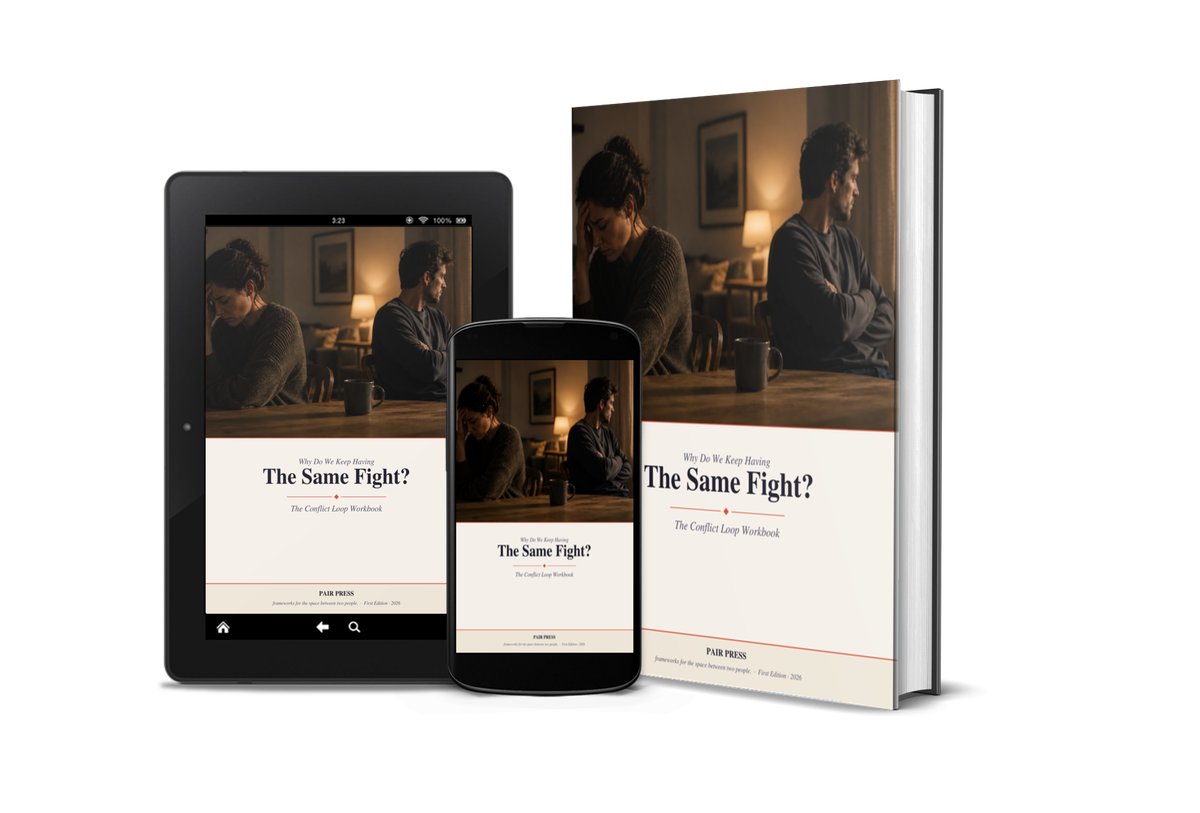
The Conflict Loop Workbook on tablet, phone and in print

Works on any screen — or printed out.

Download once and open it on your phone, tablet, or laptop. Prefer pen and paper? Print the worksheets and work through them together at the kitchen table. It's yours to keep.

PDF download Phone & tablet ready Print-friendly Yours forever
How It Works

A simple three-step path through the pattern.

You don't need to fix everything at once. You just need to see the loop clearly enough to step out of it.

1

Identify the Pattern

Pin down the exact argument that keeps coming back and the moments where it always turns.

2

Name It

Give the loop a name you both recognise. Naming it turns a blame game into a shared problem.

3

Break the Loop

Use scripts and small interruptions to make a different move the next time the pattern starts.

What Changes

The fight stops running the relationship.

"We named our loop 'The Scoreboard.' Just having a name for it changed everything — now one of us can say it and we both step back instead of digging in."

R
Riya & ArjunBengaluru

"I'd read all the relationship books. This was the first one that actually made me do something. The worksheets are short enough that we finished them."

M
MeghnaPune

"Same argument for two years. We saw it written out on paper for the first time and just looked at each other. That was the turning point."

D
Dev & SanaMumbai

Illustrative examples shown for demonstration while we gather verified reader stories. This workbook is a self-guided educational tool, not therapy or a substitute for professional care.

Questions

Before you decide.

No. It's a self-guided educational workbook built on well-known relationship research. It's a tool you work through on your own terms — not a session, not advice, and not a replacement for a professional. If things feel beyond a workbook, we point you to support resources inside.

Not at all. Plenty of people start it solo and bring their partner in once they've mapped the loop themselves. It works either way — alone to understand your side, or together to build a shared language.

You can read it in an evening, but the worksheets are designed to be revisited. Most people work through the three steps over a week or two, then keep the tracker going. There's no clock — it's yours to keep forever.

A 20-page PDF workbook — 3 steps, 7 worksheets, plus a foundation section, a progress tracker, and a support resources page. It's delivered as an instant download right after checkout, so you can open it on any device or print it.

Start Today

The loop ends when you decide to see it.

Stop bracing for the next version of the same fight. Get the workbook, map your pattern, and make a different move.

₹299
one-time · instant download
Get Instant Access
30-day money-back guarantee